
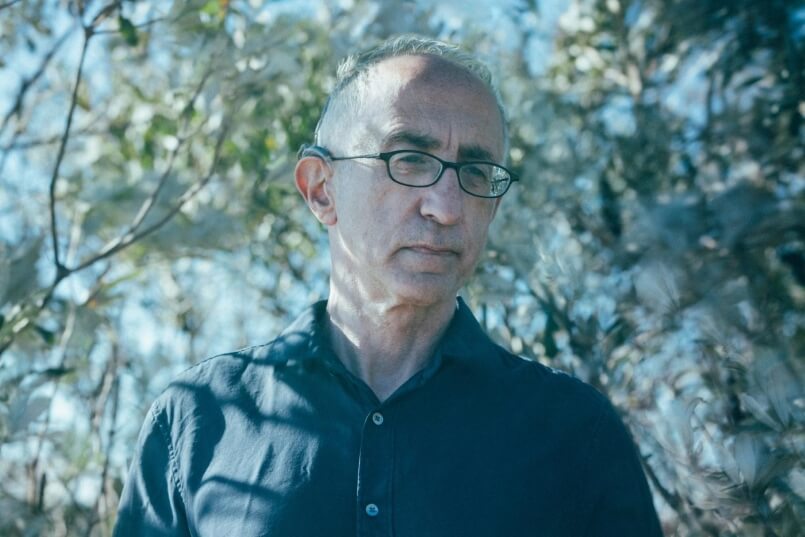
Profile
The author of Bullet Paper Rock talks about things lost — and found — in translation
‘Did you know there is no word in Arabic or French for bully?’ asks Abbas El-Zein.
He speaks both languages fluently, having been born in Beirut, in Lebanon, and educated at the French Lycée there.
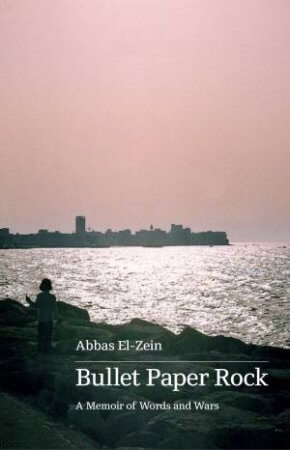
We are talking about words, because his book Bullet Paper Rock: A memoir of words and wars won the 2025 National Biography Award. Written as a series of fragments, the book celebrates the Arabic language and the many ambiguities of meaning a word can hold, while also expressing the cross-cultural misunderstandings of an author who left his native country and, like three of his five siblings, relocated to places where other languages were spoken.
Take for example the word for respect, ihtiraam. El-Zein writes in his memoir that it is ‘subtly gendered in that it comes from the root hrm, a word which in its most generic sense refers to all women within a men’s circle of protection, be they sisters, mothers, nieces or wives. It has given us hareem (for concubines, translated as the English harem) but also harram for taboo or what is beyond the pale, forbidden, in all spheres of life and not just gender relations.’
The subtleties of this linguistic mapping create strands of personal narrative that weave into an elaborate tapestry of places and events, many of them associated with violence. In 1972 when El-Zein was nine, his uncle was murdered, stabbed outside the school of which he was both the owner and the principal. His killer was never caught but died in the long civil war that ran between 1975 and 1990.
‘I still like to revert to Arabic when I am swearing under my breath.’
War is a constant presence in El-Zein’s consciousness, its incursions into his psyche captured in understated segments interspersed between more personal recollections. Sometimes the danger is distant, but sometimes it comes too close: in a particularly vivid and poignant episode, his grandmother, having fled her village ahead of an impending Israeli invasion to come to Beirut, fails to arrive. He later learns that she was killed during an Israeli air raid on a village, together with hundreds of other civilians.
‘When my uncle died I was too young to really experience grief, but when my grandmother died I was fifteen and witnessed the impact on my mother,’ says El-Zein, who recalls his mother falling silent for six days following her initial shriek of shock.
Family is at the heart of his memoir, the only certainty in a maelstrom of conflict. What is the psychological legacy of that time?
‘Some neuroses and tension are inevitable, perhaps a certain degree of caution but also a sense of being able to get through anything,’ says El-Zein, adding, ‘One thing I discovered is that I cope by wiping out memories. When friends tell me a story about some violent incident that happened twenty or thirty years ago, I have often completely forgotten it.’
He has remembered enough to share with readers terrifying encounters with Shia militiamen who arrive at any time of the day or night, including commercial area, especially at night when you might hear the murmur of voices, maybe some music, sounds from the corner shop — but I don’t miss the excessive car horns,’ he laughs.
Although Beirut enjoyed a reputation for being a glamorous city with a very lively cosmopolitan nightlife, El-Zein says he has no recollections of that era. ‘Because I was twelve when the war started, so my sense of the place is of the city’s decline and the huge sadness at that, together with the breakdown of law and order. But it still feels like a special place that you are lucky to belong to.’
What has been more difficult to accept here is what El-Zein describes as ‘political provincialism and the feeling of that trace of empire, as if we have not yet entirely come into our own in how we see ourselves. An immaturity, if you like.’
As someone with a high degree of sensitivity to the ambiguity of language and how words are not always easily translated from one language to another, he admits to being stumped initially by some Australian English expressions. ‘Thongs and bathers, they both puzzled me. I love the term CabSav [for Cabernet Sauvignon] but I am not consistent with abbreviation, so I say cozzie but not veggie. I like the term shark biscuit for an unskilled surfer but I struggle with dag: I did not get the affectionate usage of it.’
Because he is hard of hearing, television did not help El-Zein understand Australian humour. ‘Back when I arrived, shows did not have closed captions. So my understanding came from conversations with friends and parents while picking up my kids from school. Gradually I became involved and invested psychologically and emotionally.’ His children grew up not speaking Arabic ‘but acquired it as adults, by choice, so now we can converse in it. I often find myself slipping into it depending on the mood and the circumstances,’ he says, laughing. ‘I still like to revert to Arabic when I am swearing under my breath.’
Australia gave El-Zein the opportunity to be published for the first time. An essay in literary magazine Heat, then a short story in literary magazine Meanjin, and eventually a novel, Tell the Running Water, in 2001. He felt free to write Bullet Paper Rock following the deaths of his parents.
‘I wanted to understand their world more freely. When I wrote my first memoir, Leave to Remain, had a different sense of what is private and I self-censored.’
‘The words for autobiography in classical Arabic are tarjamatu nafs, which mean, literally, “self-interpretation” or “self-translation”’
As well as being one of the most popular genres in Australia, memoir has a long tradition in Arabic literature, going back at least 800 years. ‘The words for autobiography in classical Arabic are tarjamatu nafs, which mean, literally, “self-interpretation” or “self-translation”,’ he writes, finding both terms more fertile than the flat ‘autobiography’, perhaps because they offer a potential for transformation.
‘There is a word in Arabic, thikr, with multiple connotations, one of which joins the silent act of remembering to the act of speaking, and I like this because in some ways, that is what memoir does.’
In publishing, timing can make all the difference between a worthy work that is doomed to stay under the radar and one that catches the zeitgeist.
‘I handed the manuscript in [to Upswell publisher Terri-ann White] in late 2023 and it was published in early 2024. So most of the book was written before the war in Gaza. I don’t think I would have been able to write it during that time’.
El-Zein is not ready to say what his next book will be, only that he is working on two projects.
‘The beauty of writing, for me, is that it is a self-sustaining impulse, regardless of whether it will
be published.’ He feels most at ease with the essay form, combining personal observations with social commentary.
In Bullet Paper Rock he mixes emotional intensity with intellectual curiosity, leading the reader on as he investigates aspects of faith, death and cultural dislocation, with references that span from Scheherazade to Camus.
The Australian writers that eased him into Australian literature included Kate Grenville, David Malouf and Peter Carey, more recently joined by Alexis Wright and Ali Cobby Eckermann. At present, there is no planned translation of his own work into Arabic, but it would be a deeply satisfying and meaningful way to affirm his belonging to two worlds, to have his recollections of what he describes as ‘a somewhat eventful life’ return to where it all began.
Caroline Baum is the author of Only: A singular memoir (Allen & Unwin, 2017), and is a well-known literary interviewer who presents Life Sentences, a podcast about contemporary biography. She wrote about Jane Austen in Openbook Spring 2025.